


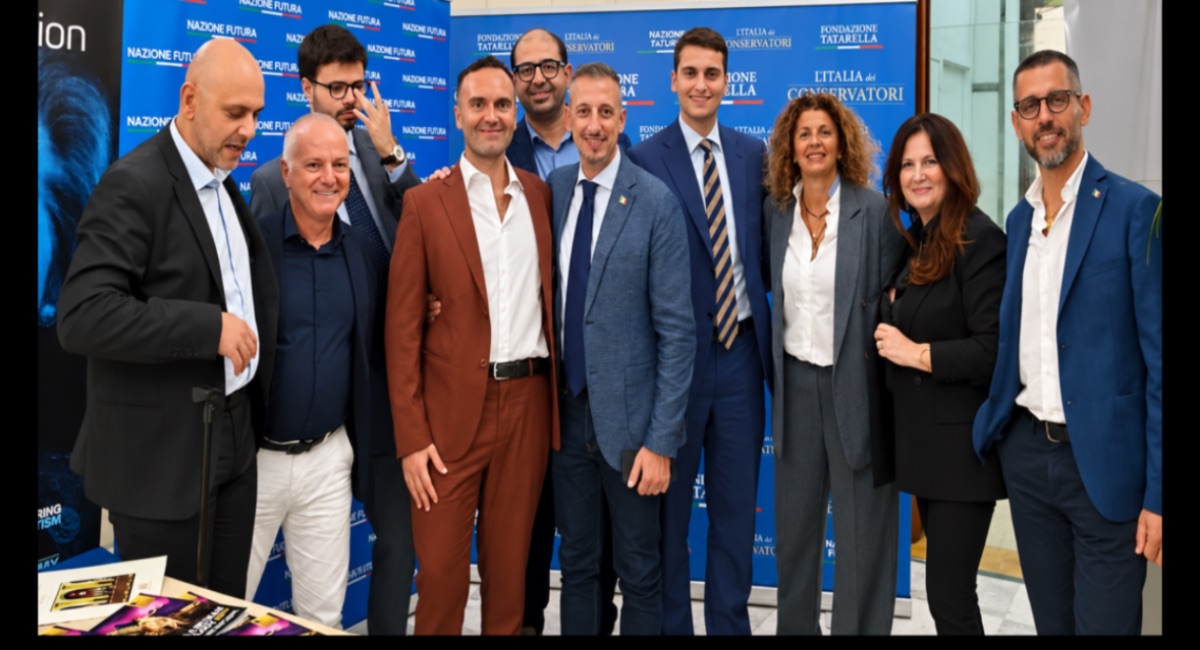

Italian conservatives gathered in Rome for the fifth edition of “L’Italia dei Conservatori,” which concluded yesterday at the Hotel Quirinale.
The event was promoted by the Giuseppe Tatarella Foundation in collaboration with Nazione Futura and New Direction.

On Friday, October 2, discussions focused on conservative values and the challenges of European security.

On the second day, however, the debate broadened to political culture, the economy, local communities and, above all, the future of Europe.

Italian Conservatives Discuss Culture and Freedom
The day began with the presentation of the book “La cultura di destra esiste,” (“Right-Wing Culture Exists”).
The discussion focused on the role of political culture in the history of the Italian right and in its current development.
Alarico Lazzaro, director of Nazione Futura’s magazine, told Italia Report USA: “The conservative cultural world stands up for freedom because freedom is the foundation of conservatism.”
Italian Conservatives Look Beyond Italy
The following panel, “Conservatives in Italy, Europe and Beyond,” brought an international group of conservative figures to Rome.
Speakers included Mario Enzler of the Heritage Foundation, Nora Junco García, Antonio Giordano, Aurelijus Veryga and Roberts Zile, Vice President of the European Parliament.
The discussion highlighted the increasingly European dimension of conservatism. At the same time, participants addressed the need to build a shared vision on the main challenges facing the continent.
Green Policies, Competitiveness and Made in Italy
The morning continued with the panel “Ideology versus Common Sense: Green Policies, Competitiveness and the Defense of Made in Italy.”
The discussion focused on the relationship between the environmental transition, industrial competitiveness and the protection of Italy’s productive system.
The issue is particularly relevant for Europe. The continent is seeking to balance environmental goals with economic growth. At the same time, it must preserve its industrial capacity.
Ferrante de Benedictis of Nazione Futura spoke to Italia Report USA on the sidelines of the panel.
“Ecology is the study of the home, and therefore it is our nature, with human beings as an integral part of it,” he said.
Moreover, de Benedictis stressed that development and growth must be combined with environmental protection.
Environmental Crime and Europe’s Responsibilities
Senator Simona Petrucci of Fratelli d’Italia also addressed environmental issues.
“Europe can do more on environmental crime,” she told Italia Report USA.
For example, Petrucci proposed “a map that identifies exactly how the waste cycle is completed.”
Her remarks brought another aspect of the environmental debate into focus: the need to combine sustainability policies with stronger oversight and greater transparency across production and waste-management systems.
European Industry and Relations with the United States
Stefano Cavedagna, a Member of the European Parliament with the ECR group, focused on the difficulties facing European industry.
“Many sectors are already in a state of permanent crisis, such as the automotive industry, which has moved outside Europe,” he said.
Therefore, Cavedagna called for a major change in direction.
“We need to make a 180-degree turn and reverse course, otherwise Europe risks no longer being there,” he said.
He then turned to the transatlantic relationship.
“Our goal is to keep the West united and maintain a strong relationship with the United States of America, also in order to address these problems,” Cavedagna said.
Identity, Local Communities and Political Communication
In the afternoon, attention shifted to identity and local communities.
First, participants focused on Nazione Futura’s local chapters. A panel on social media and legality followed.
Later, cartoonist Federico Palmaroli, known as Osho, joined Annalisa Tatarella for a discussion on the relationship between satire and politics.
The afternoon sessions therefore moved the debate from European economic issues to political communication, local networks and the role of identity in public life.
Political Stability and International Credibility
The final part of the day focused on “The Value of Stability: A Stronger Italy and the Challenges Facing the Nation.”
The panel examined the country’s prospects and the challenges of the current political phase. Once again, the European dimension remained central to the discussion.
Deputy Minister of Labor and Social Policies Maria Teresa Bellucci told Italia Report USA: “Italy is stronger than it was in the past.”
She then referred to a recent decision by the European Union.
“We are proud because we recently received approval from the European Union for the preferential tax system for Italy’s third sector,” Bellucci said.
She described the third sector as “a Made in Italy model of solidarity” that places the building of the country first.
Stability as a Strategic Factor
Ciro Francesco Miale of Nazione Futura also emphasized the importance of political stability.
“Stability is fundamental because it translates into international credibility and a solid strategic position for Italy’s industrial system, both politically and institutionally,” he said.
In this context, stability was presented not only as a domestic political issue, but also as a factor affecting Italy’s international standing and industrial position.
The discussion therefore connected national political stability with the broader European and international environment.
Fitto and Sberna Discuss the Future of Europe
The future of Europe was one of the central themes of the closing sessions.
During the panel “The Future of Europe,” introduced by Fabrizio Tatarella, European Parliament Vice President Antonella Sberna and European Commission Executive Vice President Raffaele Fitto took part in the discussion.
They were interviewed by Francesco Verderami of Corriere della Sera.
Meanwhile, the focus returned to the role Italy can play within a Europe facing new economic, political and geopolitical pressures.
From the Italian Right to the Future of the West
The event concluded with a reflection on the history of the Italian right.
The final panel, “From the MSI to Alleanza Nazionale: The True History of the Italian Right,” featured Maurizio Gasparri, Francesco Storace, Andrea Ungari and Giuseppe Valentino.
Over the course of two days, Italian conservatism addressed both its political history and the major issues of the present.
Europe, security and competitiveness were among the central themes. Identity, culture and the future of the West were also part of the debate.
At the same time, the discussions showed how Italian conservatives are increasingly placing their political agenda within a broader European and transatlantic context.
Finally, the Rome gathering highlighted the growing connection between Italy’s political and economic choices, Europe’s changing role and relations with the United States.
These issues are becoming increasingly relevant as the international balance of power continues to evolve.


