


Italy’s Senate has given final approval to a bill that directs the government to establish a new legal framework for nuclear energy. The legislation sets the stage for nuclear power to return to the country’s energy mix. Environment and Energy Security Minister Gilberto Pichetto Fratin has identified 2034–2035 as the expected timeframe for the first reactors to begin operating.
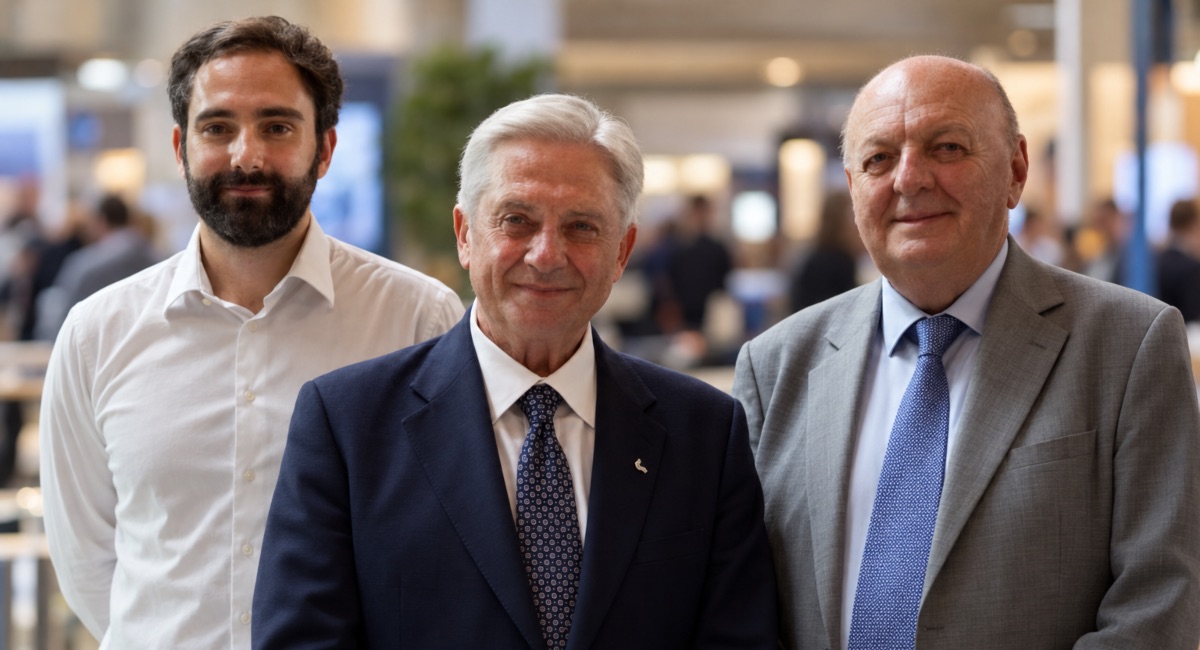
What would that mean for Italy’s energy costs and power supply? In an interview with Italia Report USA, Franco Cotana addresses those questions and explains the technologies under consideration. Cotana is CEO of RSE, Italy’s public energy research organization, and a professor of industrial thermal physics at the University of Perugia. He is also directly involved in the National Platform for Sustainable Nuclear Energy, where researchers are examining how nuclear power would fit into Italy’s electricity system.

Interview
Professor Cotana, let’s get straight to it: what effect could sustainable nuclear power have on electricity bills for Italian households and businesses?
Let’s start with the broader picture. Europe has set a goal of reaching climate neutrality by 2050. That means gradually reducing fossil fuel use, but it also means addressing the fundamental questions of energy security and independence.

Renewable sources, especially solar and wind, are and will remain central to the energy transition. But they are intermittent by nature, and solar power is also highly seasonal. That is why we need a diversified energy system that combines renewables with reliable, low-carbon sources that can generate power when needed.

Through the National Platform for Sustainable Nuclear Energy, or PNNS, we have studied a range of scenarios. Our simulations indicate that adding nuclear power to Italy’s energy mix could produce total savings of more than €17 billion. On top of that are the costs that could be avoided by making the electricity system more secure and resilient.
The major blackout on the Iberian Peninsula was a reminder that grid reliability has an economic value. A widespread power outage can cause billions of euros in damage. So the issue is not just the cost of producing a kilowatt-hour. It is also the cost of ensuring that households and businesses have a stable, secure and resilient power supply.
Which technologies are being considered, and why are they called sustainable?
First, we are looking at advanced fission technologies. They have much higher safety standards than earlier generations, particularly because they incorporate passive safety systems.
Small modular reactors, or SMRs, and micro modular reactors, or MMRs, are among the most promising options. Several projects are in development or under construction across Western countries. One significant example is Darlington, Canada, where the first of four BWRX-300 modular reactors is under construction. The first unit is scheduled to enter service by 2030.
Modularity is the key. Smaller reactors allow much of the construction work to move from the site to the factory, increasing prefabrication and standardization. Producing standardized units at scale can lower costs over time and, above all, reduce the risk of delays and unexpected problems that often affect large conventional nuclear projects.
So sustainable nuclear power does not mean simply bringing back the plants of the past. It means developing a new generation of technologies as part of a deeply decarbonized energy system that also incorporates renewables.
How much does nuclear power cost?
The largest cost is the upfront investment, known as CAPEX. Once a plant is built, fuel makes up a relatively small share of its overall costs, and the plant can operate for a very long time.
Italian research can play an important role here. RSE aims to be at the forefront of nuclear fuel research, both in fission and, further down the road, in fusion.
There is another point to consider: nuclear plants do more than generate electricity. They can also produce heat for civilian and industrial uses and help produce low-carbon hydrogen. That hydrogen can be particularly useful in industries and transportation sectors that are difficult to decarbonize.
To evaluate costs properly, we need to consider the entire energy system: the upfront investment, a plant’s operating life, its ability to produce power continuously, how it works alongside renewables, the security of energy supplies and the other services these technologies can provide.
How can we explain such a complex subject without oversimplifying it or deepening divisions?
That may be one of the biggest challenges. Views on nuclear power remain highly polarized. What we need first is reliable information, scientific understanding and transparency.
I often see a more pragmatic approach among young people. They seek out information, compare technologies and understand why it matters to diversify energy sources. We should not present nuclear power and renewables as opposing choices. The question is how to build an energy system that is low-carbon, secure, competitive and resilient.
There is an important industrial and employment dimension as well. Developing new components, technologies, safety systems and specialized skills can support advanced industries, research and highly skilled jobs. The field is already drawing young people into degree programs, master’s programs and doctoral research connected directly or indirectly to nuclear technology.
We also need to look further ahead, to nuclear fusion. Advanced fission and fusion are different technologies, with different development timelines. But investing in nuclear expertise today means building scientific, technological and industrial capabilities that will also matter for fusion.
The challenge, then, is to build a balanced energy mix. Renewables, storage, power grids, energy efficiency and nuclear power all have a role to play, each contributing in its own way to Italy’s decarbonization and energy security.


