
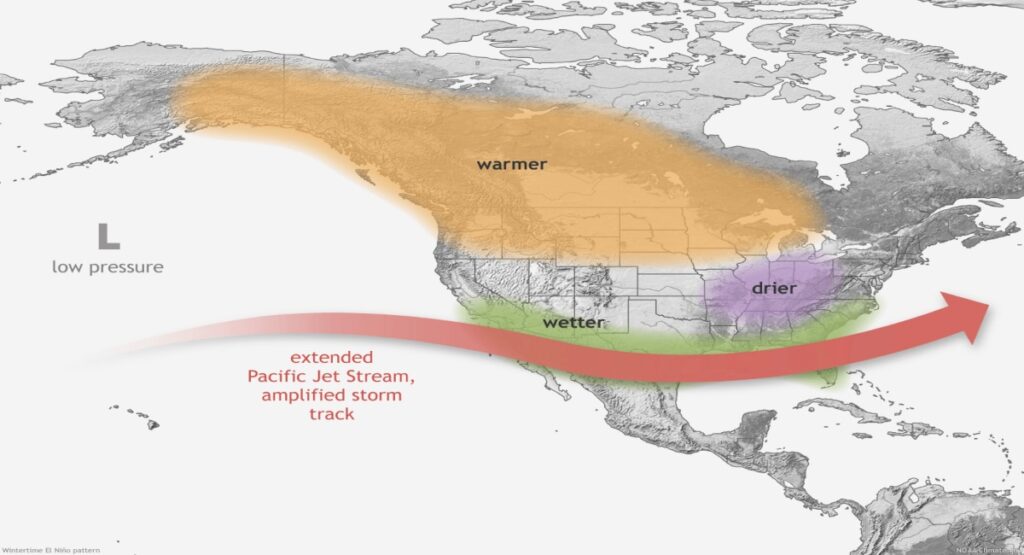
California’s winter storms have yet to arrive, but the state is preparing for them now. On September 21, Governor Gavin Newsom declared a state of emergency ahead of a rapidly strengthening El Niño. The National Oceanic and Atmospheric Administration (NOAA) estimates a 75% chance that the climate pattern will reach historic strength between October and December, surpassing previous El Niño events in records dating back to 1950. The declaration is a precautionary measure: it allows California to prepare and respond more quickly if severe weather develops.
What the declaration allows California to do
Under the governor’s proclamation, state agencies can begin protecting vulnerable communities, roads and critical infrastructure. They can position sandbags, pumps and other flood-response equipment before storms arrive.
The California National Guard can be called on to support flood response, search-and-rescue operations, engineering work and logistics. The order also allows environmental agencies to move faster on permits for projects intended to reduce flooding, landslides and debris flows.Those preparations are aimed at a threat that can take several forms. A winter storm may flood a coastal road, cut off a neighborhood or send mud and debris down a hillside. Preparing equipment and personnel in advance gives local officials more options when conditions change quickly.
What is El Niño?
El Niño is a natural climate pattern that begins in the tropical Pacific Ocean. It occurs at irregular intervals, generally every two to seven years, and its strength varies. Under ordinary conditions, trade winds push warm surface water west toward Asia and Australia. That movement allows colder water to rise from deeper in the ocean along the coast of South America.
During El Niño, the trade winds weaken and unusually warm water spreads across the central and eastern Pacific. As the ocean releases heat into the atmosphere, wind and rainfall patterns can shift far beyond the Pacific.
The effects can be felt thousands of miles away. NOAA explains the process as part of a larger interaction between the ocean and the atmosphere.
El Niño is not a hurricane or a single approaching storm. In the United States, it can tilt the odds toward a wetter winter in California and parts of the South, including Florida. It cannot tell forecasters exactly when a storm will form or which community it will hit.
Why forecasters are watching this event closely
The NOAA Climate Prediction Center’s September outlook found sea surface temperatures more than 3 degrees Celsius above average in parts of the eastern equatorial Pacific. Changes in the atmosphere were also consistent with an El Niño that was gaining strength. NOAA put the chance of a very strong event during the fall and winter of 2026–27 at greater than 90%. It estimated a 75% chance that the event’s strength during October through December would exceed that of previous El Niño events in records dating back to 1950. Those figures describe the likely strength of the climate pattern. They do not mean there is a 75% chance of a particular flood or a record-wet winter in California.
The risks extend beyond heavy rain
Along the coast, El Niño can raise water levels even before the winter’s heaviest storms arrive. As Pacific trade winds weaken, oceanic Kelvin waves can travel east and then along the coast of the Americas, temporarily lifting sea levels. High tides and powerful surf can push that water farther inland. NOAA warns that long-term sea-level rise can make the resulting coastal flooding worse.
Inland, intense rain poses a different danger. Hillsides recently burned by wildfires are especially vulnerable to rapid runoff and debris flows. Rain can sweep loose soil, rocks and charred vegetation downhill, threatening homes and roads below. The governor’s office identifies communities below recent burn areas as among those that should prepare for flooding and mudslides.
None of this guarantees that every part of California will face an exceptionally wet winter. Storm tracks still matter, and one region may experience severe flooding while another receives far less rain than expected. Newsom’s declaration reflects that uncertainty as much as the strength of the forecast: the state cannot know which storm will prove most dangerous, but it can put resources in place before that storm arrives.